
Start Understanding Critical Illness Coverage Before You Need It
Most of us do not wake up expecting our lives to pivot. Just a small moment that tugs quietly at the rhythm of your days.
A little discomfort you brushed off. A routine check-up you didn’t expect much from. A doctor’s expression that says more than words. And suddenly, the world you’ve carefully built, your responsibilities, dreams and financial commitments have changed.
Critical Illness (CI) insurance exists for that moment.
No matter who we are, life has a gentle way of reminding us that our health holds everything else together. That is where CI coverage steps in. Not to frighten you. Not to weigh you down. But to sit beside you like a quiet reassurance:
“If life surprises you… you won’t face it alone.”
What Is Critical Illness Insurance and What Does It Cover?
At the surface, it’s a lump-sum payout when you’re diagnosed with a covered illness. But at its heart? It gives you choices.
The choices to:
- Buy time. Months or years off work before you fully recover
- Afford treatments beyond your medical coverage
- Keep your household expenditure, your routine, your dignity
- Protect your children’s stability (daily life, education and future plans)
Most importantly, it gives you the freedom to focus on recovery over rushing back to life just because you are financially strained. CI coverage turns a frightening moment into a manageable one. It turns confusion into clarity. It turns fear into space.
CI coverage varies across insurers, but most Malaysian Critical Illness plans include major conditions such as cancer, heart attack, stroke, kidney failure and major organ transplant.
48 Critical Illnesses Covered | |||
|
|
|
|
*10% of the benefit’s Face Amount shall be payable, up to a maximum of RM25,000.
Why Critical Illness Is No Longer a “Later” Problem?
Not to scare. But to help you see the full picture.
Malaysia continues to see rising cases of serious illnesses, driven by lifestyle habits, ageing demographics and the growing prevalence of non-communicable diseases (NCDs). These conditions are becoming more common, appearing earlier and requiring longer recovery periods.
📌 Heart disease is still the No.1 killer in Malaysia
According to the Department of Statistics Malaysia (DOSM), ischaemic heart disease was the leading cause of medically certified deaths in 2024, accounting for 13% of all deaths.
📌 Cancer cases continue to rise
Malaysia now records more than 50,000 new cancer diagnoses every year, and according to Health Minister Datuk Seri Dr Dzulkefly Ahmad, most are detected at Stage 3 or Stage 4 - when treatment becomes more complex and costly.
📌 Hospital admissions for serious conditions remain high
Public hospitals in Malaysia recorded 2.6 million hospital admissions in 2023, showing how common it is for Malaysians to be hospitalised due to severe or worsening illnesses. Some of the top admission causes include respiratory, circulatory and infectious conditions.
How long does recovery take after a critical event requiring hospitalisation?
Stroke
Recovery after a stroke can be a lengthy process, often requiring structured rehabilitation to regain functional abilities. In Malaysia, ischaemic stroke patients typically spend an average of 4.5 days in hospital during the acute phase. Following discharge, intensive post-stroke rehabilitation helps patients regain independence, with studies showing a median recovery period of around 10.5 months.
Heart Attack
Recovery from a heart attack depends on the severity of the event, the treatment received, and the patient’s overall health. International data indicates that hospitalisation typically lasts 3 to 9 days. After discharge, patients generally need 2 to 12 weeks to regain strength and return to normal activities. This period often includes a structured cardiac rehabilitation programme, which helps strengthen the heart, support physical recovery, and reduce the risk of future complications.
Who Should Think About CI Coverage?
Not just those with health worries, but anyone with something they want to protect.
Young Working Adults
You may feel healthy, unstoppable even. But...rising NCD rates show that serious conditions are affecting younger age groups. Securing coverage early often means lower premiums and wider eligibility.
Primary Breadwinners
If your family depends on your income, a diagnosis doesn’t just affect you, it affects your entire household. A critical illness payout helps keep your family financially stable while you focus on recovery.
Those With Family History
If your family has a history of diabetes, heart disease or cancer, your own risk may be higher. Early coverage helps protect your future insurability.
Self-Employed Individuals
With no paid leave or corporate benefits, your income depends entirely on your health. CI coverage safeguards your business and your livelihood.
Why You Shouldn’t Wait?
Here are the lifehacks of CI Coverage:
● The coverage is cheaper when you are younger
● The coverage is easier to get when you are healthier
● Choices/coverage become limited when the conditions below appear
Tips: The best time to get CI coverage is when you still think you do not need it.
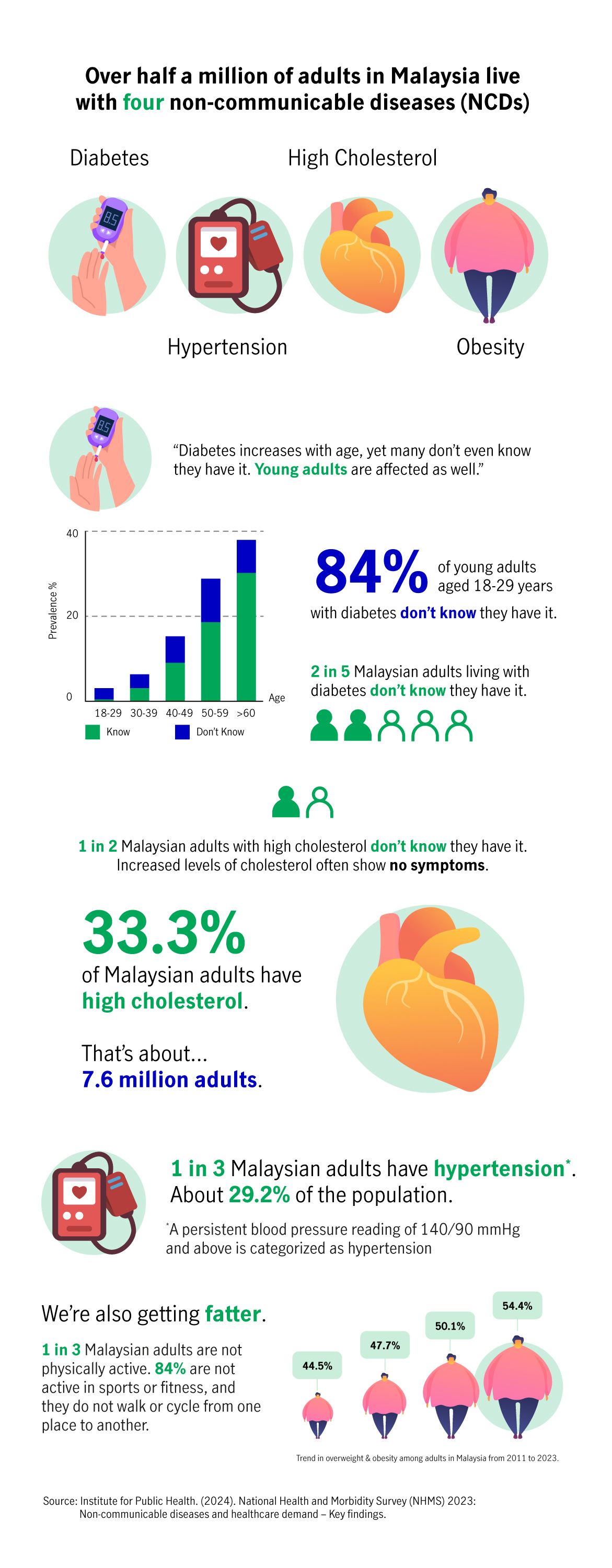
Today, there are around 15.6% of adults who are living with diabetes — and two out of five do not even know they have it.
The National Health and Morbidity Survey (2023) also highlights that many younger adults are unknowingly living with diabetes, hypertension or high cholesterol. These silent, undiagnosed NCDs raise the risk of serious complications much earlier in life.
The best time to get coverage is before symptoms appear. When you’re younger, premiums are lower, coverage options are wider and there are also fewer exclusions. Waiting until you “need it” often means higher premiums or going through extensive approval processes.
Where Should I Start?
#1 Know your risk profile.
Look at your:
These factors influence your overall risk and affect both eligibility and premiums.
#2 Decide how much coverage you need
Serious illnesses often require long recovery periods. For heart attack and stroke patients, time away from work can last multiple months, meaning paycheck replacement becomes an important financial consideration.
A helpful guideline is to choose coverage that can support you through this recovery window.
The rule of thumb for critical illness insurance in Malaysia is to have 3x of your annual salary. Why three times? In the event of a critical illness diagnosis, it takes at least three years for you to adjust your lifestyle and recover.
While Malaysia doesn’t have an official CI coverage formula, this general guideline reflects widely accepted financial planning practices and the real impact illness can have on income stability.
#3 Compare CI Plans Across Insurers
When reviewing critical illness plans, do not just focus on the headline payout. Consider these factors:
Coverage beyond just illnesses
Do not just count illnesses from the list—choose a plan that also covers hospitalisation for full protection in any medical emergency.
Early-stage detection
Early detection saves lives. With Manulife MultiCI Enrich, you get reimbursement for Multi‑Cancer Early Detection (MCED) tests, an innovative screening that can detect multiple cancers from a single blood draw.
Survival period and waiting period
Know the waiting period between diagnosis and payout to plan your finances and recovery effectively.
Exclusions and limitations
Be aware of what’s not covered to avoid unexpected gaps in protection.
Premium stability
Check whether premiums increase or change over time so you can budget ahead.
Although insurers may define coverage differently, this checklist ensures you compare actual benefits and choose one that best supports your needs.
Discover helpful content in our Knowledge Hub.

Thank you {FirstName} for contacting Manulife!
We will be in touch with you soon
Your Reference number: {ReferenceID}

Oops!
Error 404
Please excuse us
Sorry. We are processing a few things behind the scene. Please try again in a few moments.
Here’s how you can better direct your life ahead with Manulife



* PROTECTION BY PIDM ON BENEFITS PAYABLE FROM THE UNIT PORTION OF THIS PRODUCT IS SUBJECT TO LIMITATIONS. Please refer to PIDM’s TIPS Brochure or contact Manulife Insurance Berhad or PIDM (visit www.pidm.gov.my).
** The benefit(s) payable under eligible product is protected by PIDM up to limits. Please refer to PIDM’s TIPS Brochure or contact Manulife Insurance Berhad or PIDM (visit www.pidm.gov.my).

© 2020–2026 Manulife Holdings Berhad (Registration No. 197501003360 (24851-H))
General Line : (603) 2719 9228 | Customer Careline : 1 300 13 2323
Manulife Insurance Berhad ([Company No. 200801013654] (814942-M) is a member of PIDM.